
Nearly every peptide in a research catalog ships as a lyophilized powder, and nearly every protocol that uses one begins the same way: dissolving that powder in a diluent. The diluent chosen most often is bacteriostatic water. This guide explains what bacteriostatic water actually is, how it differs from the alternatives, and how laboratories decide how much to use.
What bacteriostatic water is
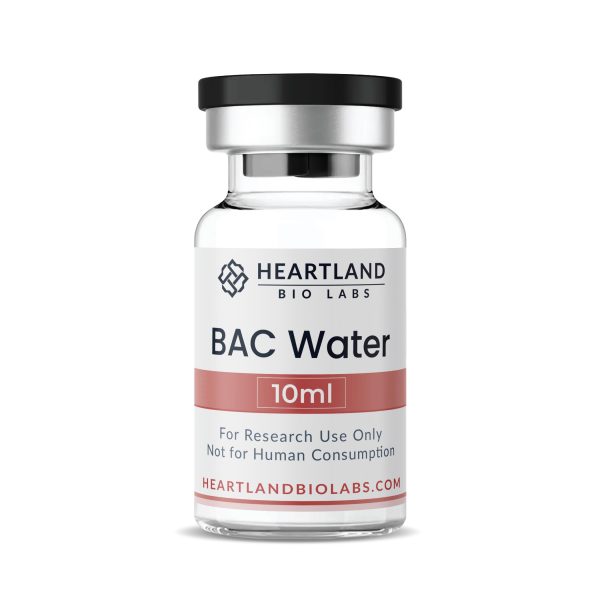
Bacteriostatic water is sterile, pharmaceutical-grade water containing 0.9% benzyl alcohol as a preservative. The name describes the function: bacteriostatic means it inhibits bacterial growth rather than killing organisms outright. The benzyl alcohol concentration is low enough to leave most laboratory applications unaffected but sufficient to suppress microbial growth inside a vial that is punctured and sampled repeatedly over days or weeks.
Bacteriostatic water versus sterile water
Plain sterile water contains no preservative at all. It is perfectly suitable for a solution that will be prepared and used once, but every needle puncture of a multi-use vial is an opportunity to introduce organisms, and preservative-free water gives them an uncontested growth medium. Bacteriostatic water exists precisely for the multi-draw case. The reconstitution math is identical for both; the difference is entirely about what happens to the solution between uses.
Why it is the standard diluent for peptides
Research peptides are typically supplied in vial quantities intended to support multiple experiments, which makes the multi-draw case the normal case. Peptides are also, as a class, stable in mildly preserved aqueous solution when refrigerated, and benzyl alcohol at 0.9% is compatible with the large majority of them. The combination of multi-draw protection and broad compatibility is why bacteriostatic water became the default answer rather than one option among many.
How much bacteriostatic water to use
The volume added determines nothing about how much peptide is in the vial and everything about the concentration of the resulting solution. Adding 2 mL to a 10 mg vial produces 5 mg/mL; adding 4 mL produces 2.5 mg/mL. There is no universally correct volume, only the volume that makes your working aliquots easy to measure. The arithmetic runs in both directions: dividing the peptide mass by the diluent volume gives the concentration, and dividing a target quantity by that concentration gives the volume that contains it.
Once the diluent volume is chosen, the arithmetic is the same for every vial: stated peptide mass divided by milliliters added gives the concentration, and any volume drawn from that solution carries a proportional share of the mass. The Heartland peptide calculator runs that reconstitution and concentration math for any vial size and diluent volume, including an aliquot table for splitting a stock solution across storage vials, so the figures in a lab notebook stay consistent from batch to batch.
Storage and working life after opening
An opened vial of bacteriostatic water is conventionally used within 28 days, the window reflected in its labeling, and stored at controlled room temperature. Reconstituted peptide solutions are a separate question: once a peptide is in solution its own stability profile governs, and refrigeration at 2-8°C is the standard practice, with gentle mixing at preparation rather than vigorous shaking. The preservative protects against microbial growth; it does nothing to slow chemical degradation of a fragile peptide.
What bacteriostatic water is not
Three confusions come up repeatedly. It is not saline: bacteriostatic sodium chloride exists as a separate product, and tonicity matters for some applications. It is not preservative-free, which matters for protocols where benzyl alcohol interferes. And it is not a sterilizing agent: it suppresses growth in a solution prepared cleanly, but it cannot rescue a vial that was contaminated at the start. Clean technique remains the first line of defense.
Sourcing quality
Bacteriostatic water is the least glamorous item in a peptide order and the one that touches every experiment. The quality markers are straightforward: pharmaceutical-grade sourcing, intact sealed vials, clear labeling of the benzyl alcohol content, and a supplier whose certificates of analysis on the peptides themselves hold up to scrutiny, since a supplier careless with its primary products is rarely careful with its supplies.
Heartland Bio Labs supplies bacteriostatic water and peptides strictly for laboratory research use. Nothing in this article is guidance for human or veterinary use.
Research compounds in this article
For research use only. Not for human consumption. Every product ships with a published certificate of analysis.