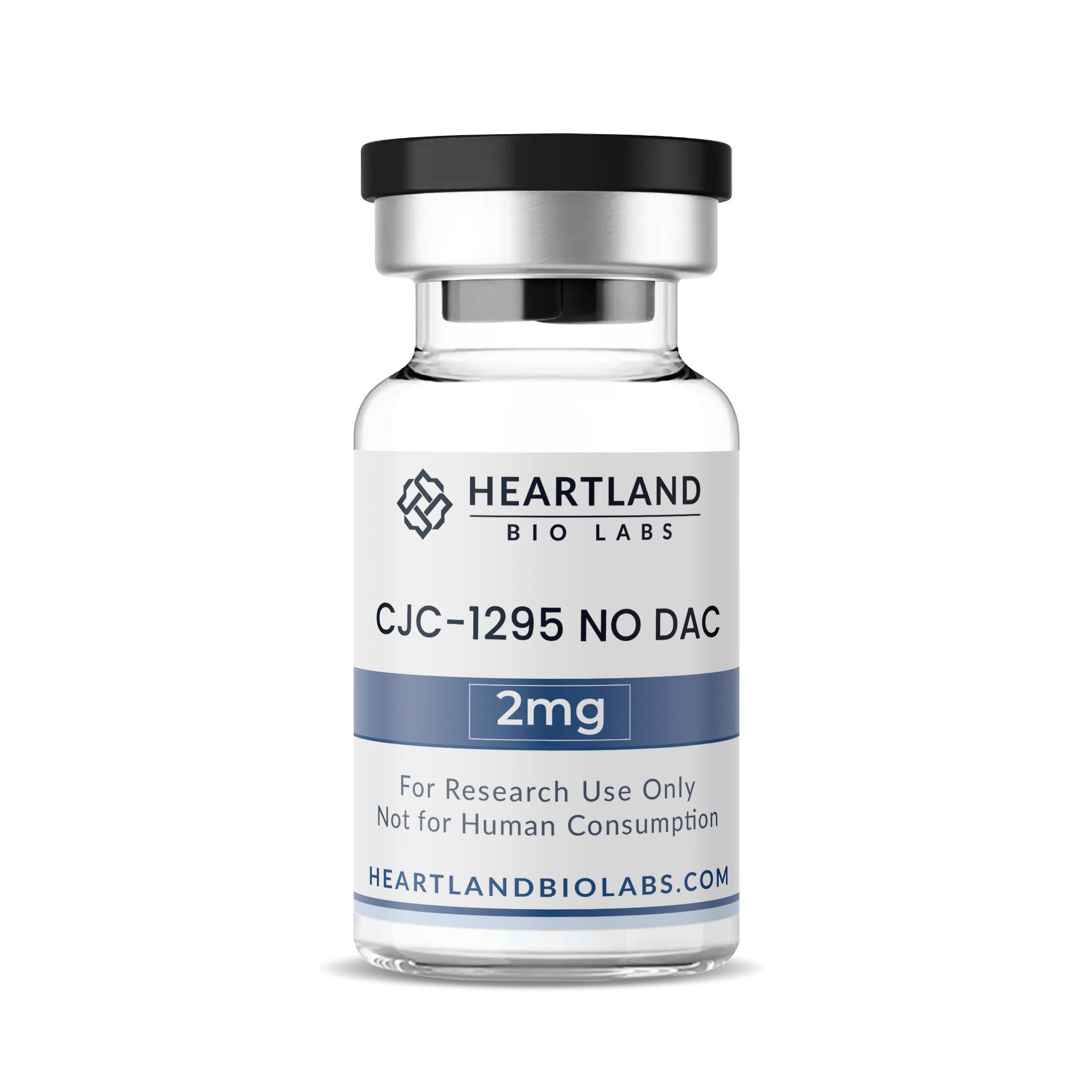
What Is CJC-1295 (No DAC)?
CJC-1295 (No DAC) is a synthetic peptide analogue of the biologically active fragment of Growth Hormone-Releasing Hormone, GHRH (1-29). In the research literature it is more precisely called Modified GRF (1-29) or tetrasubstituted GRF (1-29), a name that points to the four amino acid substitutions that distinguish it from the native sequence: D-Ala at position 2, Gln at position 8, Ala at position 15, and Leu at position 27. The substitution at position 2 is the most consequential, because native GHRH is cleaved within minutes by the enzyme DPP-IV at exactly that site. Swapping in a D-amino acid blocks the cleavage and gives the analogue meaningful stability in laboratory conditions while leaving its receptor-binding behavior intact.
No DAC vs With DAC: The Distinction That Matters
The "No DAC" in the name is not a minor labeling detail. It separates this compound from CJC-1295 with DAC, which carries a Drug Affinity Complex, a reactive group that binds the peptide to circulating albumin and extends its half-life from minutes to days. The two versions are studied for different reasons. The DAC version produces a sustained, flattened elevation of GHRH receptor signaling. The No DAC version clears quickly, which preserves the pulsatile character of the endogenous GH axis and makes it the preferred tool in research models where pulse frequency and amplitude are the variables of interest. A researcher choosing between the two is really choosing between a steady-state signal and a pulsed one. Our companion page on CJC-1295 with DAC covers what the DAC modification actually is at the chemistry level.
Where It Sits in the GH-Axis Research Family
Peptides studied on the growth hormone axis fall into two broad families. On the GHRH-analogue side sit Sermorelin, Tesamorelin, and both forms of CJC-1295, all of which act at the GHRH receptor on the pituitary. On the ghrelin-receptor side sit compounds like Ipamorelin, which act at the growth hormone secretagogue receptor, a completely different target. Because the two receptor systems are distinct, research protocols frequently examine them in combination, which is the rationale behind the paired CJC-1295 + Ipamorelin blend. Among the GHRH analogues, CJC-1295 (No DAC) is closest to Sermorelin in behavior; both are short-acting GRF (1-29) derivatives, with the tetrasubstitution giving CJC-1295 (No DAC) greater enzymatic stability.
Research Applications
Published preclinical work involving Modified GRF (1-29) centers on GHRH receptor pharmacology: receptor binding and activation studies, investigations of pituitary somatotroph signaling, and models examining pulsatile versus continuous receptor stimulation. Its resistance to DPP-IV cleavage also makes it a common reference compound in peptide stability and degradation studies. All Heartland Bio Labs compounds are supplied strictly for in vitro laboratory research by qualified professionals.
Quality Verification
Every compound we stock is tested per product by an independent analytical laboratory, with identity confirmed by mass spectrometry and purity assessed by HPLC. Certificates of Analysis are published openly in our testing data library, and customers can match their vial to its certificate through the COA portal. If you want to understand how these methods differ and what each one actually demonstrates, our testing documentation walks through the analytical chemistry in plain language.
Handling and Storage
Choosing between the No DAC and With DAC versions starts with understanding the suffix. Our article on what With DAC actually means explains the modification and how the two versions differ.
CJC-1295 (No DAC) is supplied as a lyophilized powder in sealed vials. In lyophilized form it should be stored refrigerated, protected from light and humidity. Once reconstituted with bacteriostatic water for laboratory use, solutions should be kept refrigerated and used within the timeframe appropriate to the research protocol. As with all peptides, avoid repeated temperature cycling.
Reconstitution math
Work out concentration (mg/mL), amount per volume and molarity for any vial size with the general peptide calculator. For the bench procedure see how to reconstitute peptides.
Research Use Only
This product is sold for laboratory research use only. It is not for human or veterinary use, not a drug, food, or cosmetic, and may not be used in diagnostics or therapeutics. By purchasing, the buyer confirms they are a qualified researcher and accepts our terms of sale.