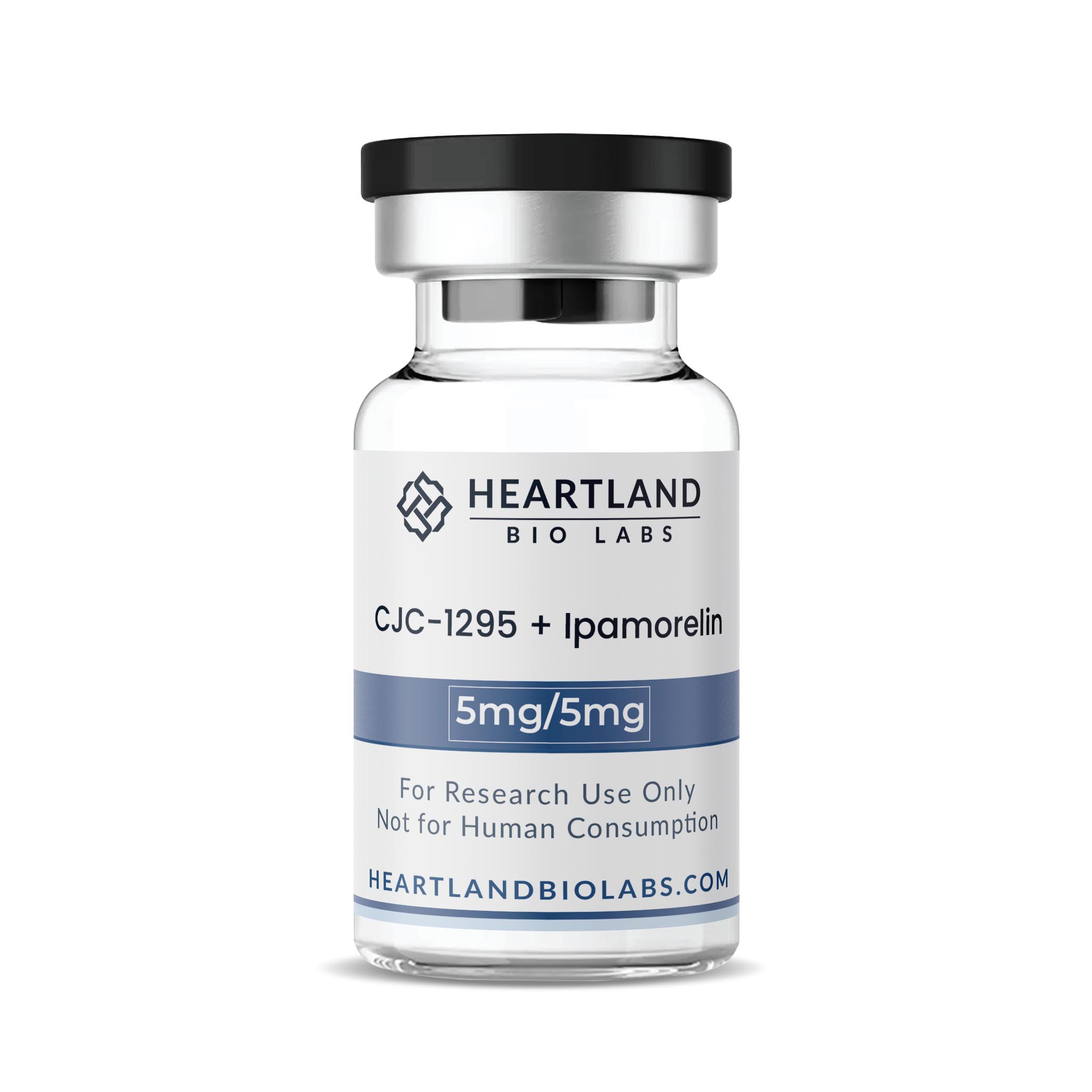
What Is the CJC-1295 + Ipamorelin Blend?
This blend co-formulates CJC-1295 No DAC, also known in the literature as Modified GRF (1-29), and Ipamorelin in one vial, 5mg of each for 10mg of total peptide content. Both compounds are studied on the growth hormone axis, but they reach it through completely different doors, and that distinction is the entire logic of the pairing. Each compound is available individually, with its full chemistry covered on its own page.
Two Receptors, One Vial
The growth hormone axis accepts input from two separate receptor systems. The GHRH receptor responds to Growth Hormone-Releasing Hormone and its synthetic analogues, the family that includes CJC-1295, Sermorelin, and Tesamorelin. The growth hormone secretagogue receptor, often called the ghrelin receptor, responds to an entirely different class of compounds, and Ipamorelin is among the most selective research tools in that class, showing minimal activity at receptors for cortisol and prolactin in published binding studies. A single vial containing one compound from each family lets a protocol stimulate both inputs simultaneously with a fixed, known ratio.
Why No DAC Is the Form Used Here
CJC-1295 exists in two forms, and the choice between them shapes the whole research profile of this blend. The No DAC form used here clears quickly, so its GHRH-receptor input arrives as short pulses that mirror the pulsatile character of the endogenous axis. Ipamorelin's secretagogue input is likewise brief. Pairing two short-acting compounds keeps the entire stimulation pattern pulsed, which is precisely what most combination protocols are designed to study. The alternative form, CJC-1295 with DAC, binds albumin and signals continuously for days, a fundamentally different input that suits different questions. Our page on the DAC modification explains the chemistry behind that difference.
Why the Pairing Appears in Research
Preclinical work has repeatedly examined whether stimulating both receptor systems produces effects that differ from either pathway alone, and the Modified GRF (1-29) plus Ipamorelin combination became a standard model for that question because both components are short-acting and receptor-selective. Studies compare the dual-input profile against single-compound baselines under matched conditions.
Where It Sits in the GH-Axis Research Family
Among our catalog, this is the only co-formulated product that spans both sides of the axis. On the GHRH-analogue side sit Sermorelin, Tesamorelin, and both forms of CJC-1295. On the secretagogue side sits Ipamorelin. A protocol built around single-pathway questions should start from the individual compounds, while combined-exposure designs are where this blend belongs. The performance category page maps the whole family in one place.
Quality Verification
Every compound we stock is tested per product by an independent analytical laboratory, with identity confirmed by mass spectrometry and purity assessed by HPLC. For blends, component-level verification is the standard that matters, and Certificates of Analysis are published openly in our testing data library with vial lookup through the COA portal.
Handling and Storage
This blend pairs one compound from each branch of the growth hormone axis family. Our GH-axis peptide family map explains the two-receptor logic and where every related catalog compound sits.
The blend is supplied as a lyophilized powder in sealed vials. Store lyophilized vials refrigerated, protected from light and humidity. Reconstitute with bacteriostatic water for laboratory use, keep solutions refrigerated, and avoid repeated temperature cycling.
Reconstitution math
Work out concentration (mg/mL), amount per volume and molarity for any vial size with the general peptide calculator. For the bench procedure see how to reconstitute peptides.
Research Use Only
This product is sold for laboratory research use only. It is not for human or veterinary use, not a drug, food, or cosmetic, and may not be used in diagnostics or therapeutics. By purchasing, the buyer confirms they are a qualified researcher and accepts our terms of sale.