
Yes. NAD+ (nicotinamide adenine dinucleotide) is a coenzyme, and not just any coenzyme: it is the central redox coenzyme of cellular metabolism, present in every living cell and required by hundreds of enzymes. What makes NAD+ unusual is that it works as a coenzyme in two fundamentally different ways, one of which consumes it, and that distinction is behind most of the modern research interest in the molecule.
What a Coenzyme Actually Is
Enzymes are proteins that catalyze reactions, but many of them cannot work alone. A coenzyme is a small, non-protein molecule that binds to an enzyme and participates directly in the reaction, usually by carrying something from one place to another: electrons, chemical groups, energy. Coenzymes are not enzymes themselves, and they are not consumed the way substrates are, at least in the classical picture. Many of the vitamins are vitamins precisely because the body uses them to build coenzymes, and NAD+ is the textbook example: it is built from niacin, vitamin B3.
NAD+ as the Classic Redox Coenzyme
In its best-known role, NAD+ is an electron carrier. During glycolysis and the citric acid cycle, enzymes strip electrons from nutrient molecules and hand them to NAD+, converting it to NADH. NADH then delivers those electrons to the mitochondrial electron transport chain, where they drive ATP production, and the molecule cycles back to NAD+ to be used again. In this role NAD+ behaves like a classical coenzyme: endlessly recycled, never used up, shuttling between its oxidized and reduced forms thousands of times.
The Consumed Coenzyme: Where It Gets Interesting
The second role breaks the classical pattern. Sirtuins, the enzyme family at the center of much modern aging research, and PARPs, the enzymes that manage DNA repair, do not borrow NAD+ and hand it back. They cleave it, using a piece of the molecule in their reactions and destroying the NAD+ in the process. In these reactions NAD+ acts less like a recycled coenzyme and more like a consumable substrate, which is why our research overview calls it the consumed coenzyme. This consumption is the mechanistic reason cellular NAD+ levels decline with age in published models: the demand from repair and regulatory enzymes rises while synthesis capacity falls, and the pool shrinks.
Why NAD+ Is Not a Peptide
A related question researchers ask: NAD+ appears in peptide research catalogs, so is it a peptide? No. Peptides are chains of amino acids joined by peptide bonds. NAD+ contains no amino acids at all; it is two nucleotides joined through their phosphate groups, chemically closer to the building blocks of DNA than to anything in a peptide vial. It appears in catalogs like ours because longevity-focused research programs study it alongside peptides, not because it is one. Its distinct chemistry has practical consequences for handling and stability, covered on our NAD+ product page.
Coenzyme, Cofactor, Co-substrate: Which Label Fits NAD+?
All three, and the terms nest inside each other. A cofactor is any non-protein helper an enzyme needs. Some cofactors are inorganic, like the magnesium or zinc ions many enzymes hold in their active sites. The organic ones are called coenzymes, and NAD+ is one of them, so NAD+ is a cofactor and a coenzyme at the same time.
Biochemists split coenzymes one step further. Some stay bound to their enzyme permanently and are called prosthetic groups; the heme in cytochromes and the FAD locked inside many flavoproteins are examples. NAD+ is the opposite case. It binds loosely, picks up its electrons, and leaves the enzyme as NADH. Because it enters and exits the reaction like a reactant, many textbooks call it a co-substrate, which is the most precise description of how it actually behaves.
Is NAD+ a Substrate or a Product?
It depends on which direction the reaction runs, and that is the reason the question comes up so often. Two examples from glycolysis make it concrete:
- NAD+ as a substrate: glyceraldehyde-3-phosphate dehydrogenase takes glyceraldehyde-3-phosphate, phosphate, and NAD+ and produces 1,3-bisphosphoglycerate and NADH. NAD+ goes in, NADH comes out.
- NAD+ as a product: lactate dehydrogenase takes pyruvate and NADH and produces lactate and NAD+. Here NAD+ comes out, which is exactly the point: this step regenerates NAD+ so glycolysis can keep running when oxygen is limited.
In the consuming reactions described above, NAD+ is unambiguously a substrate. Sirtuins, PARPs, and CD38 cleave it, releasing nicotinamide, and the molecule has to be rebuilt through the salvage pathway before it can be used again.
NAD+, NADH, NADP+, NADPH: A Quick Reference
| Form | State | Main job |
|---|---|---|
| NAD+ | Oxidized | Accepts electrons in catabolic reactions; substrate for sirtuins, PARPs, CD38 |
| NADH | Reduced | Carries electrons to the mitochondrial electron transport chain |
| NADP+ | Oxidized | Same core molecule with an extra phosphate; accepts electrons in the pentose phosphate pathway |
| NADPH | Reduced | Supplies electrons for biosynthesis and for antioxidant systems such as glutathione reductase |
The cell keeps the two pools in opposite states. Free NAD+ in the cytosol far outnumbers free NADH (ratios in the hundreds are commonly cited), which keeps oxidizing steps like glycolysis moving forward. The NADP pool is held mostly in the reduced NADPH form, ready to donate electrons. NADH is therefore not a different coenzyme from NAD+; it is the same coenzyme in its loaded, reduced state.
Is NAD+ an Enzyme?
No. NAD+ is a small molecule of about 663 daltons, not a protein, and it does not catalyze anything by itself. The confusion usually comes from the enzymes that surround it: NAMPT and NMNAT build NAD+ through the salvage pathway, dehydrogenases use it as a coenzyme, and sirtuins, PARPs, and CD38 consume it. Research on “NAD metabolism” is largely research on those enzymes and on how fast they make and spend the pool.
Quick Answers
Is NAD+ a coenzyme? Yes. It is an organic, non-protein molecule that enzymes require to carry out their reactions.
Is NADH a cofactor or a coenzyme? Both. NADH is the reduced form of the same coenzyme, and every coenzyme is also a cofactor.
Is NAD+ used up? In redox reactions, no; it cycles between NAD+ and NADH. In sirtuin, PARP, and CD38 reactions, yes; it is broken down and has to be resynthesized.
What vitamin is NAD+ made from? Niacin (vitamin B3), including nicotinic acid and nicotinamide, plus the amino acid tryptophan through a longer route.
For how the molecule is checked in the lab, see how to read a certificate of analysis; the same identity and purity questions apply to non-peptide compounds.
What This Means for Research
The two-role picture explains the shape of the preclinical literature. Redox studies treat NAD+/NADH as a measurable indicator of cellular metabolic state. Aging research focuses on the consumption side: sirtuin activation assays, PARP activity models, and studies of how restoring NAD+ pools affects markers of cellular aging. Researchers building longevity panels typically study it alongside the peptide compounds in our cognitive and longevity category. All compounds we stock are supplied strictly for laboratory research by qualified professionals.
Research compounds in this article
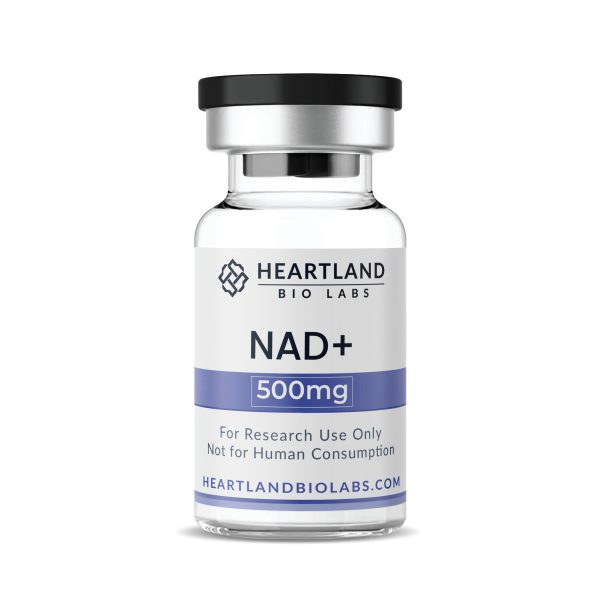
For research use only. Not for human consumption. Every product ships with a published certificate of analysis.