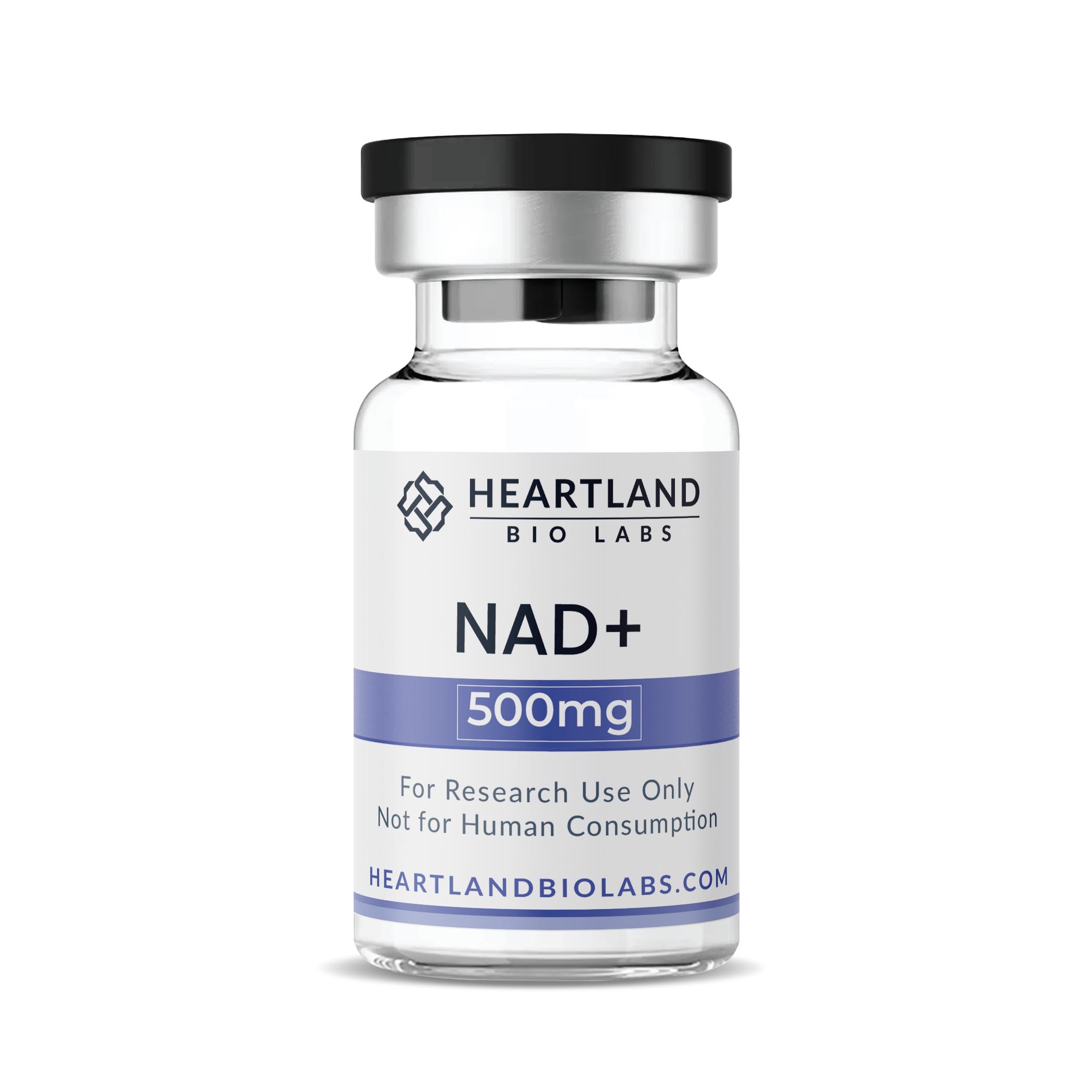
What Is NAD+?
Nicotinamide adenine dinucleotide, universally abbreviated NAD+, is a coenzyme found in every living cell. Structurally it is two nucleotides joined through their phosphate groups, one built on adenine and the other on nicotinamide, the active form of vitamin B3. It is worth being precise here: NAD+ is not a peptide. It contains no amino acids and no peptide bonds, which makes it the single exception in our catalog, and the reason its handling, stability, and analytical profile differ from everything else we stock.
Why a Coenzyme Sits in a Peptide Catalog
NAD+ earned its place in longevity-focused research catalogs because of what it does rather than what it is. Inside the cell, NAD+ cycles continuously between its oxidized and reduced forms, shuttling electrons through the reactions that produce ATP. Beyond energy metabolism, it is the required substrate for sirtuins, the enzyme family at the center of much modern aging research, and for PARP enzymes involved in DNA repair. Published work consistently shows cellular NAD+ levels declining with age across species, which is the observation that turned a metabolic housekeeping molecule into one of the most studied compounds in longevity science. Researchers building cellular-aging models often study it alongside Epithalon and 5-Amino-1MQ, the peptide-side compounds in our longevity family.
What the Research Examines
The preclinical literature spans cellular energy metabolism, sirtuin activation assays, DNA repair models, and studies of NAD+ precursor conversion. A large branch of the field examines how supplementing NAD+ or its precursors affects measured NAD+ pools in cell culture, and how those pools relate to markers of cellular aging. All Heartland Bio Labs compounds are supplied strictly for laboratory research by qualified professionals.
Handling a Dinucleotide vs a Peptide
NAD+ is hygroscopic and sensitive to heat, light, and pH extremes, and in solution it degrades faster than most lyophilized peptides. Store the lyophilized powder refrigerated, tightly sealed against humidity, and protected from light. Reconstituted solutions should be used promptly and kept cold; unlike many peptides, NAD+ solutions do not tolerate extended storage well. Reconstitute with bacteriostatic water for laboratory use and avoid repeated temperature cycling.
Strengths
We stock NAD+ in 500mg and 1000mg vials, reflecting the milligram scale at which this compound is studied, orders of magnitude above typical peptide quantities. A 100mg size is listed for smaller-scale work and joins the catalog when stocked.
Quality Verification
Every compound we stock is tested per product by an independent analytical laboratory, with identity confirmed by mass spectrometry and purity assessed by HPLC. For a small molecule like NAD+, identity confirmation matters even more than it does for peptides, since a white lyophilized powder tells you nothing about what is in the vial. Certificates of Analysis are published openly in our testing data library with vial lookup through the COA portal.
Reconstitution math
Work out concentration (mg/mL), amount per volume and molarity for any vial size with the general peptide calculator. For the bench procedure see how to reconstitute peptides.
Research Use Only
This product is sold for laboratory research use only. It is not for human or veterinary use, not a drug, food, or cosmetic, and may not be used in diagnostics or therapeutics. By purchasing, the buyer confirms they are a qualified researcher and accepts our terms of sale.