
Reconstituting KLOW is not like reconstituting a single peptide. One vial holds four compounds at fixed masses, so every milliliter of bacteriostatic water you add sets four concentrations at once, and they always move together. This article works through that math for the 80 mg KLOW vial, explains why the solution’s blue color is a useful check, and covers the handling steps that keep the vial usable. It deals with laboratory concentration and aliquot planning only.
What Is in the Vial
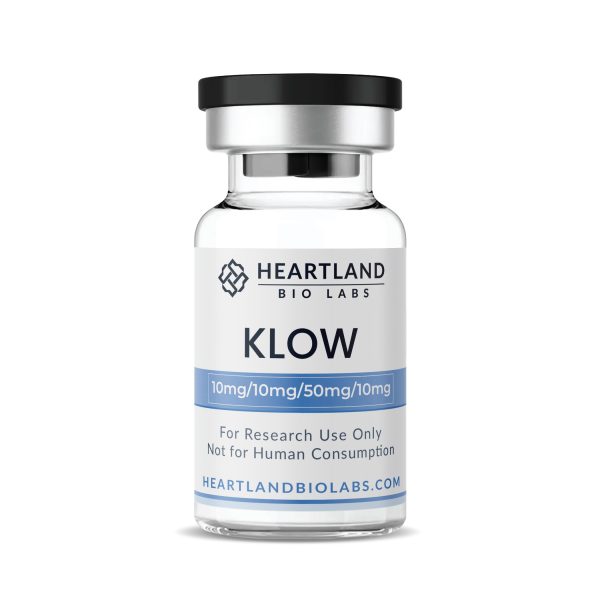
Per the component certificate for the current KLOW vial, the 80 mg blend contains:
The ratio is fixed at 5:1:1:1. GHK-Cu is always five times the concentration of each of the other three, whatever volume you choose. You cannot raise or lower one component on its own inside a blend; that is the core tradeoff of a co-lyophilized vial compared with separate single-compound vials.
Concentration by Diluent Volume
Concentration is simply mass divided by volume. For the 80 mg vial:
| BAC water added | Total blend | GHK-Cu | BPC-157, TB-500, KPV (each) |
|---|---|---|---|
| 2 mL | 40 mg/mL | 25 mg/mL | 5 mg/mL |
| 3 mL | 26.67 mg/mL | 16.67 mg/mL | 3.33 mg/mL |
| 4 mL | 20 mg/mL | 12.5 mg/mL | 2.5 mg/mL |
| 5 mL | 16 mg/mL | 10 mg/mL | 2 mg/mL |
Most labs choose a volume that makes the arithmetic easy. At 4 mL, for example, every 0.1 mL contains exactly 2 mg of total blend.
Amount per 0.1 mL Aliquot
Small aliquots are easier to reason about than concentrations. On a U-100 insulin-style syringe, 0.1 mL is the “10” marking; the markings are just volume.
| BAC water added | Total per 0.1 mL | GHK-Cu per 0.1 mL | Each other component per 0.1 mL |
|---|---|---|---|
| 2 mL | 4 mg | 2.5 mg | 0.5 mg |
| 3 mL | 2.67 mg | 1.67 mg | 0.33 mg |
| 4 mL | 2 mg | 1.25 mg | 0.25 mg |
| 5 mL | 1.6 mg | 1 mg | 0.2 mg |
For any other volume, the reconstitution calculator handles the division; enter 80 mg as the vial content and multiply the result by each component’s share from the first table.
The Blue Color Is a Built-In Check
Because GHK-Cu is the majority ingredient, a correctly made KLOW solution is visibly blue. The copper complex absorbs light in proportion to its concentration, so the same vial looks deeper blue at 2 mL than at 5 mL. A KLOW vial that reconstitutes completely colorless is worth questioning before anything else, since that points to missing or degraded GHK-Cu. Our article on why GHK-Cu turns blue explains the chemistry. Color is a screen, not a certificate: it tells you copper is present, not that the other three components are.
Reconstitution Steps
- Let the vial and the bacteriostatic water reach room temperature.
- Swab both stoppers with an alcohol pad and let them dry.
- Draw the chosen volume with a new sterile syringe.
- Add the water slowly down the inside wall of the vial rather than onto the powder cake.
- Swirl or roll gently until fully dissolved. Do not shake; vigorous agitation can foam and stress peptides.
- Check that the solution is clear and blue with no visible particles.
- Label the vial with the volume added, the resulting concentration, and the date, then refrigerate at 2 to 8 °C away from light.
The general peptide reconstitution guide covers storage and handling in more detail. For contamination control during these steps, see peptide endotoxin testing.
How GLOW Compares
GLOW is the same design minus KPV: 50 mg GHK-Cu with 10 mg each of BPC-157 and TB-500, 70 mg total. The per-component math is identical for the three shared compounds. At 4 mL, GLOW gives 12.5 mg/mL GHK-Cu and 2.5 mg/mL each of BPC-157 and TB-500, only the total drops to 17.5 mg/mL.
Quick Answers
How much BAC water for KLOW? There is no single correct volume; 2 to 5 mL covers most lab setups. Pick the volume that makes your aliquot math simple and record it on the vial.
Can I reconstitute KLOW with sterile water instead? Sterile water works for single-use preparations. Bacteriostatic water, with 0.9% benzyl alcohol, is preferred when the vial will be punctured repeatedly.
Why is my KLOW solution blue? GHK-Cu is a copper complex and makes up 62.5% of the blend by mass. Blue is expected.
Heartland Bio Labs supplies KLOW and all peptides strictly for laboratory research use. Nothing in this article is guidance for human or veterinary use.
Research compounds in this article
For research use only. Not for human consumption. Every product ships with a published certificate of analysis.