
Anyone who has handled GHK-Cu notices the same thing first: the solution is blue. Not a marketing tint, not a dye, but a genuine deep blue that sets it apart from the clear or faintly straw-colored solutions of nearly every other research peptide. That color is one of the more useful things a researcher can see with the naked eye, because it is a direct consequence of the compound’s chemistry.
The peptide and the copper
GHK is a tripeptide, glycyl-L-histidyl-L-lysine, three amino acids in sequence. On its own it is colorless. What makes GHK-Cu blue is the second half of the name: a copper(II) ion bound to the peptide. The histidine residue in the middle of the sequence, together with the terminal amine and the peptide backbone, forms a coordination pocket that holds a single copper ion. The result is a defined copper-peptide complex, and it is the copper, held in that specific geometry, that absorbs light in the red-orange part of the spectrum and reflects the blue you see.
Why the color is a signal, not a decoration
This is the part worth internalizing. The blue is not added to GHK-Cu; it is produced by the very bond that makes GHK-Cu what it is. A correctly formed copper complex is blue. A solution that reconstitutes weak, pale, or colorless is telling you something, that the copper loading is off, that the material is largely uncomplexed peptide, or that what is in the vial is not what the label claims. The color is a first, free, at-a-glance integrity check that no other peptide in a typical catalog offers.
It is not a complete check. Color tells you a copper complex is present; it does not tell you the concentration is right, the purity is high, or the peptide sequence is correct. A too-dark or oddly-hued solution can point to excess copper or contamination just as a pale one points to too little. The blue narrows the possibilities; it does not close the case.
What actually confirms identity
The laboratory answer to whether a vial is really GHK-Cu does not rely on color at all. Identity is established by mass spectrometry, which measures the molecular weight of the material and confirms it matches the copper-peptide complex rather than free peptide or a different sequence. Purity is measured by high-performance liquid chromatography, which separates the sample and reports the proportion that is the target compound. Copper content specifically can be quantified by elemental methods. The certificate of analysis is where these results live, and our guide to reading a certificate of analysis walks through what each figure means. The blue is what you see; the certificate is what you verify.
Handling the complex
The copper coordination that produces the color also shapes how the material should be handled. Copper-peptide complexes are sensitive to conditions that can strip or displace the metal, so the same careful practices that protect any peptide, gentle reconstitution, refrigerated storage of the prepared solution, protection from prolonged light and heat, matter here for the added reason that they preserve the complex itself, not just the peptide chain. A solution that has faded noticeably has changed chemically, whatever the label still says.
The practical takeaway
GHK-Cu is one of the few research compounds that shows you something true about itself before any instrument is involved. Treat the blue as the useful first-pass signal it is: a correctly formed vial should be distinctly, cleanly blue, and anything markedly off is a reason to look at the certificate rather than the label. Then let the analytical data, mass for identity, chromatography for purity, elemental analysis for copper, do the actual confirming. You can read more about the compound itself in our GHK-Cu research overview.
Heartland Bio Labs supplies GHK-Cu strictly for laboratory research use. Nothing in this article is guidance for human or veterinary use of any compound.
Research compounds in this article
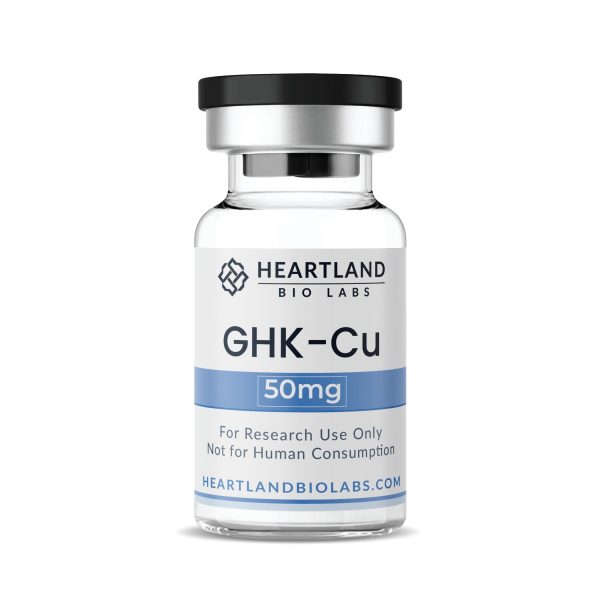
For research use only. Not for human consumption. Every product ships with a published certificate of analysis.